HBOT and VO2max: What the 1,032-Patient Study Found
A 2026 study of 1,032 patients found VO2max rose about 9% after HBOT at 2 ATA, with no control group. What it shows, what it can't, and how it compares.
This content is for informational purposes only and does not constitute medical advice. Always consult a healthcare professional. Read full disclaimer
A study published in November 2026 looked at 1,032 patients who had a fitness test before and after a course of hyperbaric oxygen therapy (HBOT). On average, their peak oxygen uptake (VO2max) rose by 2.29 mL/kg/min, about 9%, after roughly 59 sessions at 2 ATA. Gains were seen in every age group and every diagnosis group. But the study had no control group: it cannot show how much of the change came from HBOT rather than from repeating the test, exercising more, or other changes over three months. The authors say so themselves, and the patients were selected because they were fit enough to do a maximal exercise test.
This article explains what the study measured, how it fits with the two smaller controlled trials from the same centre, and what it does not tell you. For the wider question of HBOT and ageing, see our articles on HBOT and longevity and HBOT for anti-aging.
What did the study do?
The study, by Yaakobi, Hadanny, Efrati and colleagues, was published in Frontiers in Aging on 11 November 2026. It was carried out at the Sagol Center for Hyperbaric Medicine and Research, Shamir (Assaf Harofeh) Medical Center, Israel.
| Question | What the study did |
|---|---|
| Design | Retrospective cohort: records of patients treated between 2018 and 2025 were analysed afterwards. No control or sham group |
| Who was included? | 1,032 non-hospitalised patients aged 15-90 (mean 55.6, 65% men) with a valid maximal exercise test before and after HBOT. 1,083 had a baseline test; 51 were excluded for a missing or invalid second test |
| Why were they treated? | Healthy ageing with no specific diagnosis (39%), PTSD (16%), long COVID (12%), traumatic brain injury (8%), mild cognitive impairment (7%), fibromyalgia (6%), stroke (4%) and other conditions (8%) |
| What was the treatment? | At least 40 sessions (mean 58.8), five days a week, in a multiplace chamber: 90 minutes of 100% oxygen at 2 ATA, with a 5-minute air break every 20 minutes |
| What was measured? | Cardiopulmonary exercise testing (CPET) on a bike or treadmill, about 1 week to 1 month before the course and 2-4 weeks after it |
The air breaks are not only a safety measure. The group designs its protocol around the hyperoxic-hypoxic paradox: the idea that cells respond to the repeated rise and fall in oxygen as if oxygen were scarce, switching on repair and blood-vessel-growth signals.
What did it find?
All seven of the main fitness measures improved on average (all p < 0.001):
- Peak oxygen uptake (VO2max) rose by 2.29 mL/kg/min (95% CI 2.10 to 2.47), about 9% from baseline. Absolute VO2max also rose, by 154 mL/min.
- Oxygen uptake at the first ventilatory threshold, a measure of the effort you can sustain, rose by 2.12 mL/kg/min, also about 9%.
- Oxygen pulse (oxygen taken up per heartbeat) rose by 0.79 mL/beat.
- Ventilatory efficiency improved, with the VE/VCO2 slope falling by 1.07.
Patients lost 0.85 kg on average. The authors calculate that weight loss alone explains about 0.23 of the 2.29 mL/kg/min gain.
Not everyone improved by the same amount
The average hides a wide spread, from a fall of 9.4 to a rise of 26.7 mL/kg/min. Fitness researchers often count change in METs (1 MET = 3.5 mL/kg/min):
- 53.9% of patients gained at least half a MET, and 26.6% gained at least 1 MET.
- 40.6% stayed within half a MET of where they started.
- 5.5% got worse by at least half a MET.
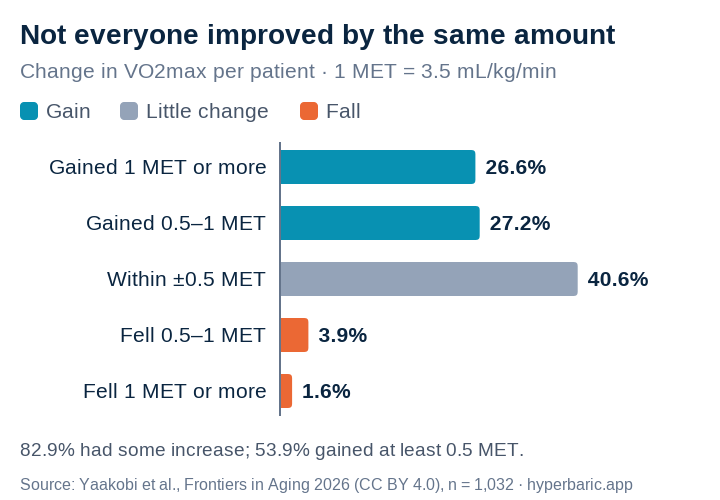
Age, sex, body mass index and diagnosis explained only about 3% of the differences between patients. Patients with diabetes improved less on average (+1.57 vs +2.43 mL/kg/min).
By age and diagnosis
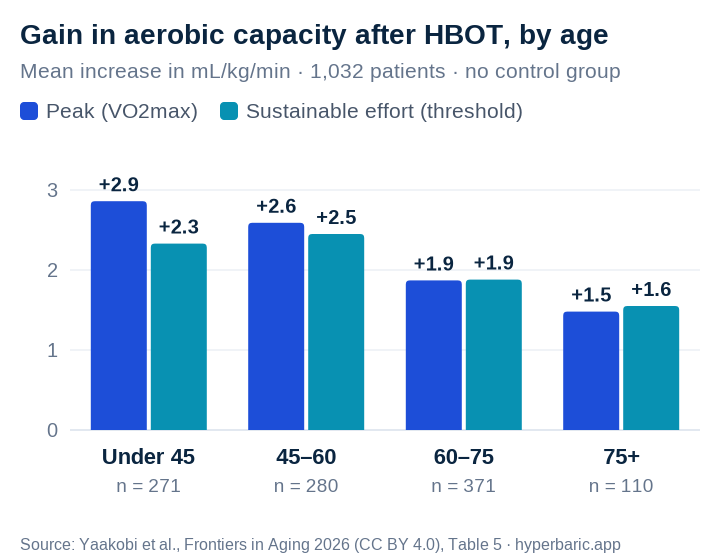
Gains were smaller with age: VO2max rose by 2.86 mL/kg/min in patients under 45 and by 1.48 in those aged 75 and over. Sustainable effort held up better in the oldest group, rising by 1.55 mL/kg/min.
| Group | Patients | Change in VO2max (mL/kg/min) |
|---|---|---|
| Healthy ageing | 406 | +2.29 |
| PTSD | 162 | +1.90 |
| Long COVID | 127 | +2.49 |
| Traumatic brain injury | 82 | +2.57 |
| Other conditions | 78 | +3.18 |
| Mild cognitive impairment | 74 | +1.50 |
| Fibromyalgia | 65 | +2.18 |
| Stroke | 38 | +2.47 |
Source: Yaakobi et al. 2026, Table 4.
Why does VO2max matter?
VO2max is the most oxygen your body can use during hard exercise. It falls with age, and the American Heart Association has argued that cardiorespiratory fitness should be treated as a clinical vital sign. Large studies link higher fitness with longer life:
- In 122,007 patients who had a treadmill test at the Cleveland Clinic, the extra risk of death linked to low fitness was comparable to or greater than that linked to smoking, diabetes or coronary artery disease.
- In 750,302 US veterans, the least fit had about four times the risk of death of the extremely fit.
These are observational links between fitness and survival. They do not show that raising VO2max with HBOT changes anyone's risk. The study did not measure illness or deaths, and its authors write that the changes "should not be interpreted as estimates of morbidity or mortality reduction". Regular physical activity remains the established way to improve fitness.
What can't this study tell you?
The authors acknowledge most of these points themselves, in their limitations and safety sections:
- No control group. People who repeat an exercise test often do better the second time simply because they know what to expect. Without an untreated comparison group, that cannot be separated from any effect of HBOT.
- Activity was not tracked. Patients were given general advice to stay active, but exercise, rehabilitation, lifestyle and medication changes during the three months were not recorded.
- Testers knew the timing. The tests were run and read as part of routine care, by staff who knew whether a test was before or after treatment.
- The patients were selected. The centre treated 9,563 patients in the period, and only those whose doctors judged a maximal exercise test appropriate and feasible were tested. Patients treated for wounds, radiation injury or emergencies were not included. The results describe patients well enough to exercise hard, not everyone who has HBOT.
- One centre, one group. All the data come from the Sagol Center. Shai Efrati, the senior author, declares that he is head of the medical advisory board and a shareholder at AVIV Scientific Ltd. The study was funded by the hospital's research fund.
- Side effects were not recorded systematically. The authors report no serious adverse events, but note that common ones such as ear barotrauma and temporary short-sightedness were not counted.
- No long-term follow-up. The second test came 2-4 weeks after the last session. Whether the gain lasts is unknown.
How does it compare with the controlled trials?
The authors' main argument is that their results match two earlier randomised trials of the same protocol, run at the same centre:
| Master athletes trial (2022) | Older adults trial (2024) | |
|---|---|---|
| Who | 37 healthy master athletes aged 40-50 (31 analysed) | 63 sedentary adults over 64 |
| Treatment | 40 sessions of 100% oxygen at 2 ATA for 1 hour | 60 sessions of the 90-minute, 2 ATA protocol |
| Comparison | Sham sessions breathing air at 1.02 ATA, double-blind | No intervention; participants knew their group |
| VO2max result | Larger increase with HBOT than sham | +1.91 mL/kg/min after HBOT, more than control |
Sources: Hadanny et al. 2022, Hadanny et al. 2024.
In the 60-75 age group, the new study's gain (+1.87 mL/kg/min) is close to the older-adults trial (+1.91). That consistency is worth noting. But only the athletes trial had a sham and blinding, and it was small. Both trials come from the same group, and their authors also disclosed employment with, or shares in, AVIV Scientific. We did not find an independent replication. The new study is best read as a large real-world record that fits with those trials, not as proof on its own. The authors call for prospective controlled studies.
Does this apply to mild chambers?
No. Every patient was treated with 100% oxygen at 2 ATA in a hard-shell multiplace chamber. Many wellness studios use soft "mild" chambers at around 1.3 ATA, which were not tested here. The Undersea and Hyperbaric Medical Society (UHMS) considers mild hyperbaric oxygen unproven, and improved fitness is not an accepted HBOT indication (see our guide to accepted indications). If a provider quotes this study, ask what pressure and oxygen level you would actually get. Our hard-shell vs soft-shell guide explains the difference.
What this means for you
- It is an open research question. The study is large and consistent with the group's earlier trials, but it cannot show that HBOT caused the improvement.
- The protocol is a big commitment. It means about 60 sessions of 90 minutes, five days a week, for around three months, at 2 ATA.
- There are side effects. Middle ear barotrauma is one of the most common, and temporary short-sightedness often develops over a long course at 2 ATA or more, according to a review of HBOT side effects. See HBOT side effects.
- Talk to your doctor first, especially if you have heart or lung disease, and ask any clinic how its protocol compares with the one studied.
If you are interested in sport, our article on HBOT for sports recovery covers what controlled trials found for soreness and injuries. To compare providers, find a hyperbaric clinic near you.
Sources
- Yaakobi E, Bentzur K, Hadanny A, et al. Hyperbaric oxygen therapy and cardiorespiratory fitness: the strongest prognostic markers of health and ageing improve across more than 1,000 patients, consistent with controlled trials. Frontiers in Aging. 2026;7:1962894. Open access (CC BY 4.0).
- Hadanny A, Hachmo Y, Rozali D, et al. Effects of hyperbaric oxygen therapy on mitochondrial respiration and physical performance in middle-aged athletes: a blinded, randomized controlled trial. Sports Medicine - Open. 2022;8(1):22.
- Hadanny A, Sasson E, Copel L, et al. Physical enhancement of older adults using hyperbaric oxygen: a randomized controlled trial. BMC Geriatrics. 2024;24(1):572.
- Hadanny A, Efrati S. The hyperoxic-hypoxic paradox. Biomolecules. 2020;10(6):958.
- Ross R, Blair SN, Arena R, et al. Importance of assessing cardiorespiratory fitness in clinical practice: a case for fitness as a clinical vital sign. A scientific statement from the American Heart Association. Circulation. 2016;134(24):e653-e699.
- Mandsager K, Harb S, Cremer P, et al. Association of cardiorespiratory fitness with long-term mortality among adults undergoing exercise treadmill testing. JAMA Network Open. 2018;1(6):e183605.
- Kokkinos P, Faselis C, Samuel IBH, et al. Cardiorespiratory fitness and mortality risk across the spectra of age, race, and sex. Journal of the American College of Cardiology. 2022;80(6):598-609.
- Heyboer M 3rd, Sharma D, Santiago W, McCulloch N. Hyperbaric oxygen therapy: side effects defined and quantified. Advances in Wound Care. 2017;6(6):210-224.
- Undersea and Hyperbaric Medical Society. HBO indications.